Boy, that was a real cliffhanger, wasn't it? I didn't kill the yeast. The Parker House Rolls rose and were a lovely part of our Thanksgiving dinner, a groaning table of beautiful food prepared by new and old friends. We ate chicory salad with persimmons and pomegranate seeds, mashed potatoes and gravy, brussels sprouts with roasted chestnuts and a brozed Narragansett heritage turkey. 5 years ago there were only 400 of this breed of turkey alive--now the population has boomed, a bird saved from extinction.
The bird was smaller than the broad-breasted turkeys that have become the Butterball norm, almost resembling an oversize duck, with big thighs, wings and drumsticks. Our friend Zack roasted it to a deep, even brown, a broad expanse of crispy skin with succulent meat that actually had flavor.
There is a great deal to be thankful for.
Friday, November 25, 2005

Wednesday, November 23, 2005
Rollin' Rollin' Rollin'
We have a situation here. Mere hours from Thanksgiving I'm having some major dinner roll problems. Let me set the scene for you. In Bangor, Maine, there's a little bakery by the name of Frank's Bakehouse. It's on Main Street, not too far from the Catholic church, and they make all sorts of down home baked goods, like whoopie pies and superlative doughnuts (rumor is they still use lard.) But the crowning jewel of Frank's are their dinner rolls. They are the pull-apart kind, yeasty and a little sweet, with a nicely bronzed cap. They come in white or wheat and they are the definitive roll, the benchmark bread.
I'm a long way from Bangor. So I decided that I would make rolls myself. With only a small number of ingredients and very few variables I figured I could probably make some Frank-esque rolls on my own. I was wrong. Last year I tried some sweet potato rolls using a recipe from the most excellent cookbook, Home Baking, by Jeffrey Alfond and Naomi Duguid. They weren't bad, but they weren't Frank's. This year I decided I would use a recipe of my own creation, a mixture of challah and brioche techniques and ingredients. I baked them last night, and they were pretty good. Not Frank's. In desperation I called the bakery and asked them for the recipe. They were at first reticent, then said that they could give it to me, but it was a recipe that made 30 dozen. No problem! I'll rescale it!! Then they said that they were actually too busy to give out the recipe just then--could I call after Thanksgiving?
Clearly they don't understand my situation. After Thanksgiving? The woman at Frank's was kind enough to tell me the ingredients, which she claimed were just the usual: flour, butter, sugar, eggs, yeast. Yeah, that's right--the same ingredients I used. So now I'm stumped. This morning I decided I'd do a second batch of just plain old Parker House Rolls (did you know Ho Chi Min worked at the Parker House, as a busboy?) but I think that I might have killed the yeast with a too hot milk-butter mixture. Fulled formed, in a warm, draft-free place, they haven't risen at all. I know this is a bad sign, I'm just not ready to admit it, yet.
Will midnight find our heroine mixing yet another batch of dinner roll dough? A full report on Friday.
I'm a long way from Bangor. So I decided that I would make rolls myself. With only a small number of ingredients and very few variables I figured I could probably make some Frank-esque rolls on my own. I was wrong. Last year I tried some sweet potato rolls using a recipe from the most excellent cookbook, Home Baking, by Jeffrey Alfond and Naomi Duguid. They weren't bad, but they weren't Frank's. This year I decided I would use a recipe of my own creation, a mixture of challah and brioche techniques and ingredients. I baked them last night, and they were pretty good. Not Frank's. In desperation I called the bakery and asked them for the recipe. They were at first reticent, then said that they could give it to me, but it was a recipe that made 30 dozen. No problem! I'll rescale it!! Then they said that they were actually too busy to give out the recipe just then--could I call after Thanksgiving?
Clearly they don't understand my situation. After Thanksgiving? The woman at Frank's was kind enough to tell me the ingredients, which she claimed were just the usual: flour, butter, sugar, eggs, yeast. Yeah, that's right--the same ingredients I used. So now I'm stumped. This morning I decided I'd do a second batch of just plain old Parker House Rolls (did you know Ho Chi Min worked at the Parker House, as a busboy?) but I think that I might have killed the yeast with a too hot milk-butter mixture. Fulled formed, in a warm, draft-free place, they haven't risen at all. I know this is a bad sign, I'm just not ready to admit it, yet.
Will midnight find our heroine mixing yet another batch of dinner roll dough? A full report on Friday.
Wednesday, November 16, 2005
Promises, Recipes
Loyal readers, do you remember my promise to track down the recipe for my mother's apple cake? I deliver forth the goods. I made it last night (it took about 5 minutes, literally, to put this baby together. The recipe is so simple that it can hardly even be called a recipe. What a delight.) and found it just as good as I remembered. I served it with a dollop of whipped cream, but it'd be nice for breakfast or tea or as a little afternoon snack. There wasn't any leftover, or I would be having that little snack right about now.
So here goes:
A Simple Little Apple Cake from Mrs. Stimets
2 cups diced apple (peeled or not, doesn't really matter)
1 cup sugar (white sugar or a mix of white sugar and light brown sugar)
1 cup flour
1/2 tsp. baking soda
1/2 tsp. salt
1 tsp. cinnamon
1 egg, beaten
1/3 cup vegetable oil
1/2 cup nuts, toasted and chopped (I used walnuts)
Mix the sugar with the apple cubes and let stand until most of the sugar has dissolved. Mix together the dry ingredients. Add the dry ingredients to the apples. Stir in the egg and the oil. Mix well until incorporated. Add nuts. (At this point the batter will not look promising. It will look like there isn't enough batter relative to the apple cubes. You will be feeling discouraged. Don't worry.) Pour the batter into a greased 8 inch pan (square or round) and bake in a 375 degree oven for about 30 minutes, until nicely browned and a tester inserted in the center comes out clean.
So here goes:
A Simple Little Apple Cake from Mrs. Stimets
2 cups diced apple (peeled or not, doesn't really matter)
1 cup sugar (white sugar or a mix of white sugar and light brown sugar)
1 cup flour
1/2 tsp. baking soda
1/2 tsp. salt
1 tsp. cinnamon
1 egg, beaten
1/3 cup vegetable oil
1/2 cup nuts, toasted and chopped (I used walnuts)
Mix the sugar with the apple cubes and let stand until most of the sugar has dissolved. Mix together the dry ingredients. Add the dry ingredients to the apples. Stir in the egg and the oil. Mix well until incorporated. Add nuts. (At this point the batter will not look promising. It will look like there isn't enough batter relative to the apple cubes. You will be feeling discouraged. Don't worry.) Pour the batter into a greased 8 inch pan (square or round) and bake in a 375 degree oven for about 30 minutes, until nicely browned and a tester inserted in the center comes out clean.
Tuesday, November 15, 2005
Hot Dates
This morning I made a date relish to accompany our braised chicken dinner. The relish is a simple combination of sliced fresh dates, cilantro, lemon juice and olive oil and should be a good compliment to the spicy braise.
Dates are definitely an undervalued American fruit. In most supermarkets the only dates available are those odd desicated bits that make their way into GORP and fruitcake. Even when you do occasionally see fresh they are usually the most common Medjool variety which, while quite tasty, are only one of the dozens of varieties available, ranging in size from tiny to more substantial, from slightly sweet to pure maple syrup, from Barhi to Deglet Noir and back again. Plenty of other countries use dates liberally, including Australia, where sticky date pudding is practically a religion and throughout the Middle East and North Africa, where they are eaten out of hand and cooked alongside savory meats.
I always think about dates this time of year, with Thanksgiving fast approaching. Not only does their complex flavor pair well with fall fruits, rich caramels and bitter chocolate, they also always played a starring role at our Thanksgiving table. My grandmother, who otherwise was not a good cook, would make her famous stuffed dates every year for the holiday. The dates, which are stupidly simple, are very rich and very delicious and are just the thing to serve alongside your pies or as an accompaniment to that lazy fireside glass of port. In our house, the bowl usually appears on the coffee table just after the Macy's day parade cheers in Santa Claus and they are steadily consumed throughout the afternoon, which may account for our lackluster performance at the dinner table. Each date must be wrapped in a small square of tin foil; the foil keeps the filled dates from drying out, and it makes each one seem like a little gift.
To make these dates, pit a whole mess of fresh dates by slicing the side of each one and carefully extracting the pit. (Medjool dates are actually good for this recipe because they are firm and can be easily stuffed.) In a small bowl, combine softened cream cheese with powdered sugar. (How much? That depends on how many dates you have. You want the filling to taste a bit like not-very-sweet cream cheese frosting.) If you are feeling fancy, you can add a little lemon zest to the filling, too. (N.B. Grammy didn't do that.) Using a teaspoon or your fingers, pinch off a little of the cream cheese mixture and stuff it into the date. Squish the date around the filling, and top the hole with a toasted walnut. Wrap the date in foil. Repeat.
Dates are definitely an undervalued American fruit. In most supermarkets the only dates available are those odd desicated bits that make their way into GORP and fruitcake. Even when you do occasionally see fresh they are usually the most common Medjool variety which, while quite tasty, are only one of the dozens of varieties available, ranging in size from tiny to more substantial, from slightly sweet to pure maple syrup, from Barhi to Deglet Noir and back again. Plenty of other countries use dates liberally, including Australia, where sticky date pudding is practically a religion and throughout the Middle East and North Africa, where they are eaten out of hand and cooked alongside savory meats.
I always think about dates this time of year, with Thanksgiving fast approaching. Not only does their complex flavor pair well with fall fruits, rich caramels and bitter chocolate, they also always played a starring role at our Thanksgiving table. My grandmother, who otherwise was not a good cook, would make her famous stuffed dates every year for the holiday. The dates, which are stupidly simple, are very rich and very delicious and are just the thing to serve alongside your pies or as an accompaniment to that lazy fireside glass of port. In our house, the bowl usually appears on the coffee table just after the Macy's day parade cheers in Santa Claus and they are steadily consumed throughout the afternoon, which may account for our lackluster performance at the dinner table. Each date must be wrapped in a small square of tin foil; the foil keeps the filled dates from drying out, and it makes each one seem like a little gift.
To make these dates, pit a whole mess of fresh dates by slicing the side of each one and carefully extracting the pit. (Medjool dates are actually good for this recipe because they are firm and can be easily stuffed.) In a small bowl, combine softened cream cheese with powdered sugar. (How much? That depends on how many dates you have. You want the filling to taste a bit like not-very-sweet cream cheese frosting.) If you are feeling fancy, you can add a little lemon zest to the filling, too. (N.B. Grammy didn't do that.) Using a teaspoon or your fingers, pinch off a little of the cream cheese mixture and stuff it into the date. Squish the date around the filling, and top the hole with a toasted walnut. Wrap the date in foil. Repeat.
Thursday, November 10, 2005
French Breakfast
About four years ago I spent a summer working at La Varenne cooking school in Burgundy, France. Anne Willan, the owner and founder of the school, is a prolific writer and publishes a new book almost every year with the help of various recipe testers and editorial assistants who clamor for the opportunity to spend a summer in France. She has a wealth of arcane cooking information (do you know the traditional garnish for babas au rhum? Well, do you?) and is a demanding and exacting boss. I won't sugarcoat it--some of the chores were terribly dull and aggravating. Other chores, like picking fruit from the ancient potager (made famous by Amanda Hesser's book The Cook and the Gardener) and turning it into jams and jellies, were great satisfying work.
Though Anne and her husband know and like great food, it always appeared that they had very few vices. While we stagieres would sneak pieces of chocolate and potato chips, Anne stuck to the basic French doctrine: lots of vegetables, some cheeses and the occasional dessert, red wine and long walks after lunch. But being British, she did love her shortbread. Every week one of the kitchen minions would be assigned the duty of producing a weeks worth of French sable cookies, which we would then individually wrap and give to Anne. She would keep them in her bedroom and she and her husband would each eat one every morning. We all adopted the habit of a sable with our morning coffee, though often times ours would be the packaged variety made by Bonne Maman. The French word sable refers to the texture of these cookies, sandy, meaning they are so tender that the crumble delicately when you bite into them.
I got thinking about all this because I bought a shortbread cookie from Berkeley's Cheeseboard Collective yesterday, thinking that I would have it for dessert. But I forgot about it, only to remember this morning when I saw the butter stained bag on the counter. The cookie, alongside my morning cup of coffee, took me back 6,000 miles and 4 years to a big chateau in a little French town. It remains one of the finest breakfasts imaginable.
Anne's basic sable recipe:
1 1/2 cups flour
1/2 teaspoon salt
1/2 cup sugar
3 egg yolks
1 teaspoon vanilla
7 tablespoons butter
Sift the flour onto the work surface and make a well in the center. Put the salt, sugar, egg yolks and vanilla in the well. Pound the butter with a rolling pin to soften it, add it to the other ingredients into the well and work them with the fingers of one hand until throughly mixed and the sugar is partially dissolved. Using a pastry scraper, gradually draw in the flour then work the dough until smooth. Chill at least 30 minutes (you can keep the dough in the refridgerator for up to a week, provided it is well wrapped.
Roll the dough out to a thickness of 1/4 inch and cut out shapes using a round or decorative cutter. Transfer them to a baking sheet and brush with an egg wash or a little heavy cream. Bake them in a 375 degree oven until lightly browned, about 10-15 minutes. Transfer to a rack to cool.
Though Anne and her husband know and like great food, it always appeared that they had very few vices. While we stagieres would sneak pieces of chocolate and potato chips, Anne stuck to the basic French doctrine: lots of vegetables, some cheeses and the occasional dessert, red wine and long walks after lunch. But being British, she did love her shortbread. Every week one of the kitchen minions would be assigned the duty of producing a weeks worth of French sable cookies, which we would then individually wrap and give to Anne. She would keep them in her bedroom and she and her husband would each eat one every morning. We all adopted the habit of a sable with our morning coffee, though often times ours would be the packaged variety made by Bonne Maman. The French word sable refers to the texture of these cookies, sandy, meaning they are so tender that the crumble delicately when you bite into them.
I got thinking about all this because I bought a shortbread cookie from Berkeley's Cheeseboard Collective yesterday, thinking that I would have it for dessert. But I forgot about it, only to remember this morning when I saw the butter stained bag on the counter. The cookie, alongside my morning cup of coffee, took me back 6,000 miles and 4 years to a big chateau in a little French town. It remains one of the finest breakfasts imaginable.
Anne's basic sable recipe:
1 1/2 cups flour
1/2 teaspoon salt
1/2 cup sugar
3 egg yolks
1 teaspoon vanilla
7 tablespoons butter
Sift the flour onto the work surface and make a well in the center. Put the salt, sugar, egg yolks and vanilla in the well. Pound the butter with a rolling pin to soften it, add it to the other ingredients into the well and work them with the fingers of one hand until throughly mixed and the sugar is partially dissolved. Using a pastry scraper, gradually draw in the flour then work the dough until smooth. Chill at least 30 minutes (you can keep the dough in the refridgerator for up to a week, provided it is well wrapped.
Roll the dough out to a thickness of 1/4 inch and cut out shapes using a round or decorative cutter. Transfer them to a baking sheet and brush with an egg wash or a little heavy cream. Bake them in a 375 degree oven until lightly browned, about 10-15 minutes. Transfer to a rack to cool.
Tuesday, November 08, 2005
For Spacious Skies

My parent's have been in town visiting over the weekend, which meant lots of exploring and recreational eating, two of my favorite things. Friday night I took them to Los Jarritos on 20th and South Van Ness, a Mexican restaurant owned by the Reyes family. It's a step up from many of the Mission District spots, both in decor and in food. Their Friday night special of posole (a brothy tomato based soup studded with bits of roasted pork shoulder and tender hominy) and the housemade flour tortillas are particularly worthy of note, though they make a fine chile rellenos and the service is kind and efficient.
Saturday morning the road trip began, with a quick stop at the Ferry Plaza Farmer's Market so my folks could marvel at California's bounty and we could load up on provisions. An hour later, laden with Acme's ham and cheese turnovers, a crostata from Frog Hollow, strip steaks from Niman Ranch, Cowgirl Creamery cheeses (a gruyere and a local goat), mushrooms, greens and just-picked carrots, we returned to the car and the road ahead.
Our destination was the wilds of Yosemite, a place I had never been and was anxious to see. It was, in a word, breathtaking. The road rose to the sky and every turn afforded vistas, granite monoliths and giant sequoias. We greeted the cool evening with wood stoves cranked and steaks off the grill, topped with sauteed mushrooms and roasted potatoes. As the sky darkened the stars appeared in earnest, brighter and closer than back here on earth. I can't wait to return.
Still, it felt like a shock to leave the park and, some 4-odd hours later, be sitting in the swank bar area of The Slanted Door. A day of hiking left us sleepy but hungry, and the bright, clean flavors of chef Phan's food--a mix of Vietnamese, French, and California ingredients and technique--were just the thing to perk us up. I have to admit I was hesitant to eat there, having heard reports of overpriced, not as good as when it was on Valencia Street, too large to serve good food, etc. It was an excellent meal. Standouts included the green papaya salad, a brilliantly balanced combination of ingredients, the manila clams with crispy pork belly (which I wasn't sure I would like but found myself lapping the bowl) and yellowtail with a soy-chili dipping sauce. They also offer an addictive japanese eggplant dish, with the rich flavor of coconut milk and green chiles. I was pleased to see that the dessert menu didn't offer too many gimmicks of the lychee, green tea or mango variety so commonly seen in "Asian" restaurants. Rather, it was an edited assortment of fine flavors--a pumpkin bread pudding with apples and chestnuts, a pear tart with pear sorbet, a fine creme brulee and Chinese cinnamon ice cream.
The whirlwind California tour now complete (my parent's are, as I write, winging their way back to Vermont), we'll have to return to our former routine. I began the day, as I always do when there isn't anything better around, with a bowl of yogurt sprinkled with grape nuts. It's back to the grind, I suppose. Sure is nice to know, though, that 4 hours away there's a little piece of paradise waiting.
Tuesday, November 01, 2005
We're from the country--and we like it that way
To me, California still seems like a vast uncharted land. There are still places not all that far from my home that feel completely untouched by development and I find it easy to imagine the landscape that early explorers must have discovered upon hitting the coast. Thanks to mighty preservation Route 1 winds along a coast dotted with trees instead of houses, rocky outcroppings instead of tourist shacks. It's so gorgeous that you can't understand why every road isn't choked with people, clamoring for the view.
We spent the weekend up in the Anderson Valley, which is quickly becoming (or has already become) the home of some very fine wine, produced by some very nice folks. The cosy valley offers just the right climate for grapes, including pinot noir, chardonnay, pinot gris and syrah and the area is dotted with top-notch wineries that eschew Napa's snobbery and tasting fees in favor of nice, neighborly banter and generous pours. We arrived at Navarro Vineyard's tasting room just before closing, but still had time to enjoy a flight of their wine. I think the Kahn's are making some superior wine, none of which sell for more than $30 a bottle. They are easy drinking wines that stand up well to food, and their gerwurztraimner is this year's Thanksgiving wine: dry, complicated, hinting at apricots, maybe. Hinting at delicious, for sure.
Navarro's 2003 pinot noir accompanied the dinner we enjoyed a few hours later at the Boonville Hotel. We stayed in the hotel, a ten room affair just off the main road, with a lovely patio and gardens and roosters crowing in the wee morning hours. The hotel is owned by the Schmitt family (the folks that sold the French Laundry to Mr. Keller) and the kitchen is overseen by Johnny Schmitt. His parents own the Apple Farm, just down the road in Philo, an organic orchard that produces cider and fruit, as well as offering lodging and cooking classes. I have heard the cooking classes, taught by Sue Schmitt, book a year in advance and are well worth it. Apple Farm's organic apples, most unusual varieties that grow well in Philo, are brought to the ferry building's Saturday farmer's market.
The Boonville's food was exceptional, made doubly so by the roaring fire in the dining room and the cool air outside. We ate Sonoma duck with polenta and olives and Niman Ranch pork with roasted apples and braised radicchio and found that they were both enhanced by the local wine. Dessert was a coffee pot de cream and hand-churned ice cream, the latter served with delicate Mexican wedding cookies and pecan shortbread dipped in chocolate. The best part was that we only had to totter up a flight of stairs to reach our room.
The next morning found us at the Meyer Family Winery, just down the road in Yorkville, where 10am was met with glasses of port and Scharffenberger chocolate. Matt Meyer is a friend of a good friend, so he showed us around, explained their wine and port production, and generously spent his time with us before sending us down the lane with some of their ambrosial port, just the thing to cap off holiday meals. Currently their distributorship is quite small and limited to the West Coast, but it's definitely one to keep your eye out for. The flavor is sweet and rich and well-balanced--though port is high-alcohol you never feel like you're being overwhelmed.
Not only did Boonville and the Anderson Valley feel like a great break from the city, it also felt like home. Here's hoping it stays that way.
We spent the weekend up in the Anderson Valley, which is quickly becoming (or has already become) the home of some very fine wine, produced by some very nice folks. The cosy valley offers just the right climate for grapes, including pinot noir, chardonnay, pinot gris and syrah and the area is dotted with top-notch wineries that eschew Napa's snobbery and tasting fees in favor of nice, neighborly banter and generous pours. We arrived at Navarro Vineyard's tasting room just before closing, but still had time to enjoy a flight of their wine. I think the Kahn's are making some superior wine, none of which sell for more than $30 a bottle. They are easy drinking wines that stand up well to food, and their gerwurztraimner is this year's Thanksgiving wine: dry, complicated, hinting at apricots, maybe. Hinting at delicious, for sure.
Navarro's 2003 pinot noir accompanied the dinner we enjoyed a few hours later at the Boonville Hotel. We stayed in the hotel, a ten room affair just off the main road, with a lovely patio and gardens and roosters crowing in the wee morning hours. The hotel is owned by the Schmitt family (the folks that sold the French Laundry to Mr. Keller) and the kitchen is overseen by Johnny Schmitt. His parents own the Apple Farm, just down the road in Philo, an organic orchard that produces cider and fruit, as well as offering lodging and cooking classes. I have heard the cooking classes, taught by Sue Schmitt, book a year in advance and are well worth it. Apple Farm's organic apples, most unusual varieties that grow well in Philo, are brought to the ferry building's Saturday farmer's market.
The Boonville's food was exceptional, made doubly so by the roaring fire in the dining room and the cool air outside. We ate Sonoma duck with polenta and olives and Niman Ranch pork with roasted apples and braised radicchio and found that they were both enhanced by the local wine. Dessert was a coffee pot de cream and hand-churned ice cream, the latter served with delicate Mexican wedding cookies and pecan shortbread dipped in chocolate. The best part was that we only had to totter up a flight of stairs to reach our room.
The next morning found us at the Meyer Family Winery, just down the road in Yorkville, where 10am was met with glasses of port and Scharffenberger chocolate. Matt Meyer is a friend of a good friend, so he showed us around, explained their wine and port production, and generously spent his time with us before sending us down the lane with some of their ambrosial port, just the thing to cap off holiday meals. Currently their distributorship is quite small and limited to the West Coast, but it's definitely one to keep your eye out for. The flavor is sweet and rich and well-balanced--though port is high-alcohol you never feel like you're being overwhelmed.
Not only did Boonville and the Anderson Valley feel like a great break from the city, it also felt like home. Here's hoping it stays that way.
Thursday, October 20, 2005
Doughnuts
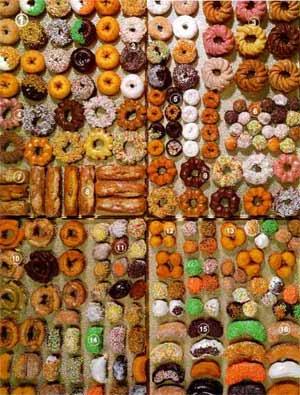
Last night, someone at work (my part time job, mind you, and nothing glamourous--I'm the reservationist) brought me a doughnut fresh from the fryer, a little experiment by one of the cooks in pastry, drizzled with a little confectionary sugar glaze. It was, of course, delicious.
Doughnuts are a food that I can get really emotional about. When I was a kid, my father once drove me to a friends house on a snowy Sunday morning. Our Pontiac station wagon (the kind with the faux bois decals) couldn't make it up the back road, wheels spinning on the ice, so I offered to get out of the car and walk. After all, the house was just up over that rise, past a small pond and to the right, an old Vermont farmhouse.
Hours later, my friends mother called my dad to see when I was coming over. My father realized that he'd dropped me on the wrong country lane, where I had been walking, and walking, and walking. What he didn't know was that after I had walked for a few hours and it had started to snow a little old man pulled up in a Jeep. It was the first and only car I had seen since being dropped off, so I followed my 8 year old instincts and took a ride with him to his house where his wife, I swear to god, was making doughnuts. From scratch. It was like the best kid's dream, ever. I don't remember wanting to go home, but I do know that when my father finally arrived in a borrowed truck to rescue me, the old man's wife sent me packing with a brown sack of fresh sugar donuts, the grease staining the bag.
I only mention this story so that you will understand my stance on doughnuts. Despite years living in Boston, I've come to the conclusion that Dunkin' Donuts are NOT GOOD DOUGHNUTS. To me, a plain doughnut means a plain cake doughnut, unglazed, unsugared. The fluffy kind with sugar coating? That's a glazed doughnut, having nothing to do with plain doughnuts. My favorite of all, though, which are nearly ubiquitous in apple country this time of year, are apple cider doughnuts. The spicy, dense cake, when fresh from the fryer, has an outer crust that crunches slightly when you bite into it. So far, in San Francisco, I have found no traces of cider doughnuts. The closest doughnut shop, Happy Donut, must be a front for some other type of operation, because they give you a bags worth of donuts for the price of one. They are decent, super sweet, but no cider doughnut.
The origin of the doughnut is difficult to determine. Variations on the fried dough theme were popular throughout Europe long before the signature doughnut as we know it came to American shores. One of the first mention of doughnuts is in Washington Irving's "History of New York" published in 1809, where he describes balls of dough fried in hog's fat that resembled oversize walnuts (the nut in doughnut, presumbably). And a small plaque at a home in Rockland, Maine, identifies that spot as the birthplace of the doughnut hole (1847), the brainchild of a Maine seaman.
At any rate, one of my favorite spots for cider doughnuts is the Cold Hollow Cider Mill, in Waterbury, Vermont. Though you cannot order their doughnuts online (a freshness question, I'm sure, though I'd take a stale one of their doughnuts over many others) you can order their cider donut mix. I can't attest to the quality, but if you have a hood fan and a dream, I suggest you try it out.
Tuesday, October 18, 2005
The Birthplace of the Noodle
An archaelogical dig in Northwestern China has unearthed some new culinary information: China is the birthplace of the noodle. Chinese archaelogists found an overturned earthenware bowl containing noodles, preserved under layers of ash. The noodle bowl was found at the late Neolithic site of Laija, a site dated at 4,000 years old. The discovery conclusively proves that it was the Chinese who first supped on noodles, not the Arabs or the Italians as previously considered.
The noodles closely resemble the hand-stretched wheat noodles that are currently eaten throughout Northern China, though those found at the dig site were made from millet, a crop that grows well in the semi-arid climate of Northwest China.
In honor of this discovery I suggest you all go out for Chinese tonight.
The noodles closely resemble the hand-stretched wheat noodles that are currently eaten throughout Northern China, though those found at the dig site were made from millet, a crop that grows well in the semi-arid climate of Northwest China.
In honor of this discovery I suggest you all go out for Chinese tonight.
Into the Kitchen
Recently I've had friends confess that they read my blog as a procrastination technique, a break from the daily grind. Nothing could make me happier, as reading other people's food blogs comprises a large portion of my work days, too. But I've found a much more effective way to avoid the chore of trying to sell stories to people that don't want them: cooking.
We're having some guests for dinner tonight, new friends. It's only a Tuesday but I've settled on an elaborate menu that requires lots of advance preparation. I'm trying, in a small way, to impress them, since they know that I cook a lot and write about food and I'm sure they are expecting something more than spaghetti and meatballs. Making a meal like this goes against everything that I ever advise people who are nervous about cooking for guests. "Make something simple," I always crow, "and make it really good." I'm the queen of the roasted chicken and mashed potatoes, the grande dame of soup as dinner with bread, cheese, and salami, and maybe a salad to round things out. Generally, when I go to other peoples houses for dinner, I'm relieved to hear that we are having a simple meal and nervous when they announce they have purchased something they have never cooked before. The words you don't want to hear as a dinner guest: "What do you usually do with squab?" Uh-oh.
Today I'm at a frustrating place with my working life, so I made up this menu as a way to excuse myself from the computer legitimately. I couldn't write! I was cooking! To further justify my slackerdom, I tried to pick some new things to make (along with some old things) so that I'd at least be learning something along the way. So, for tonight, it's garlic toasts with braised greens (kale, broccoli rabe and spinach), a little gorgonzola and a poached egg, tiny roasted squash tortellini with sage and brown butter, pork loin with garden herbs, roasted potatoes and a little cherry tomato salad, and something chocolate (TBD) for dessert.
Now, back to the kitchen.
We're having some guests for dinner tonight, new friends. It's only a Tuesday but I've settled on an elaborate menu that requires lots of advance preparation. I'm trying, in a small way, to impress them, since they know that I cook a lot and write about food and I'm sure they are expecting something more than spaghetti and meatballs. Making a meal like this goes against everything that I ever advise people who are nervous about cooking for guests. "Make something simple," I always crow, "and make it really good." I'm the queen of the roasted chicken and mashed potatoes, the grande dame of soup as dinner with bread, cheese, and salami, and maybe a salad to round things out. Generally, when I go to other peoples houses for dinner, I'm relieved to hear that we are having a simple meal and nervous when they announce they have purchased something they have never cooked before. The words you don't want to hear as a dinner guest: "What do you usually do with squab?" Uh-oh.
Today I'm at a frustrating place with my working life, so I made up this menu as a way to excuse myself from the computer legitimately. I couldn't write! I was cooking! To further justify my slackerdom, I tried to pick some new things to make (along with some old things) so that I'd at least be learning something along the way. So, for tonight, it's garlic toasts with braised greens (kale, broccoli rabe and spinach), a little gorgonzola and a poached egg, tiny roasted squash tortellini with sage and brown butter, pork loin with garden herbs, roasted potatoes and a little cherry tomato salad, and something chocolate (TBD) for dessert.
Now, back to the kitchen.
Wednesday, October 12, 2005
Nota Bene
My dining companion on that Italian voyage (and on nearly all voyages before or thereafter) reminded me that at that same restaurant in La Spezia we also had a first course of nearly perfect pesto, made with local Genovese basil and good parmigiano, tossed with fresh pasta, tiny cubes of potato and blanched green beans. A true taste of the Ligurian coast. How could I have forgotten?
A few days ago I accused Sarah of never remembering meals (well, meals that I make), an accusation that stemmed from her apparant lack of reverence for some brisket with tzimmes that I made for her brother's return from Iraq last spring. She kept calling it pot roast. I kept reminding her it was brisket. Then, she would feign remembrance: "Oh, yeah, the one that you made in the dutch oven with the potatoes." Nope, the one I made in the roasting pan with carrots and prunes, the one that I browned a piece of cow the side of New Jersey for, using only our warped roasting pan and my Yankee ingenuity.
Well, it's not really life or death now, is it? The point is that there are lots of good meals to be had, in seaside Italian towns and right at home. The point isn't brisket or top round, just that eating well with good company is one of lifes greatest pleasures.
A few days ago I accused Sarah of never remembering meals (well, meals that I make), an accusation that stemmed from her apparant lack of reverence for some brisket with tzimmes that I made for her brother's return from Iraq last spring. She kept calling it pot roast. I kept reminding her it was brisket. Then, she would feign remembrance: "Oh, yeah, the one that you made in the dutch oven with the potatoes." Nope, the one I made in the roasting pan with carrots and prunes, the one that I browned a piece of cow the side of New Jersey for, using only our warped roasting pan and my Yankee ingenuity.
Well, it's not really life or death now, is it? The point is that there are lots of good meals to be had, in seaside Italian towns and right at home. The point isn't brisket or top round, just that eating well with good company is one of lifes greatest pleasures.
Tuesday, October 11, 2005
Ciao, Chow
Today I started daydreaming about some time that I spent in Italy a few years ago. A good friend rented a massive house on a hill in a sleepy Tuscan town as a birthday present to herself. Over the course of two weeks friends came and went, and house dinners were collections of food finds we had each discovered on our respective journeys through the countryside. One night I provided porchetta I had bought at Dario Cecchini's butcher shop in Panzano, the famed butcher who recites Dante and plays opera while slicing your meat. Another night, my contribution was a nicoise salad, made with Italian canned tuna in olive oil.
One day we planned to meet my friend Nicolas, a Belgian who works for the Italian chocolate company Venchi. Venchi's chocolate is very, very good, and I have a particular place in my heart for their Cuor di Cacao, tiny squares of ultra-bitter chocolate. Nicolas was a new transplant to the company headquarters, in Cuneo, Italy, near the Alps, and didn't know much about the great Italian villages. We checked a map and agreed to meet halfway, in a seaside town called La Spezia. After lots of wrong turns in Tuscan towns, we finally arrived. La Spezia, as it turns out, lacks all the character, charm and beauty of the nearby tourist hot-spot of Portofino. It's a working town, a port city that still boasts a very active port--and not much else. The pink buildings lining the waterfront were black with grime, the streets were almost completely devoid of people and I saw a rat the size of a small dog emerge from a trashcan. Bella Italia this was not.
We wandered for a while looking for a place for dinner. One shack on the water looked promising until we walked closer and the smell of rotting fish brought tears to our eyes. Finally, we settled on an ordinary restaurant with an unsurprising menu and a surly waiter.
We ordered the fish for two, a whole fish roasted over vegetables. For the first time since arriving in La Spezia, we were pleasantly surprised. The whole fish, of name unknown, arrived in a broad copper pan, gently laid across thinly sliced potatoes and cubes of tomatoes, seasoned simply with fennel and red pepper flakes. The potatoes were crispy of the edges and silky where the fish had protected them from the heat. The fish was tender, moist and perfectly fresh. It was a great meal, made more so because our expectations had been so low. Though Nicolas had forgotten the promised chocolates, much to the dismay of the gang back at the house, we were able to find the autostrada home, cutting our four hour voyage down to a mere two. Though we vowed never to return to La Spezia, here I am, years later, recounting a splendid meal in a town hardly worth another thought. Bella Italia, indeed.
One day we planned to meet my friend Nicolas, a Belgian who works for the Italian chocolate company Venchi. Venchi's chocolate is very, very good, and I have a particular place in my heart for their Cuor di Cacao, tiny squares of ultra-bitter chocolate. Nicolas was a new transplant to the company headquarters, in Cuneo, Italy, near the Alps, and didn't know much about the great Italian villages. We checked a map and agreed to meet halfway, in a seaside town called La Spezia. After lots of wrong turns in Tuscan towns, we finally arrived. La Spezia, as it turns out, lacks all the character, charm and beauty of the nearby tourist hot-spot of Portofino. It's a working town, a port city that still boasts a very active port--and not much else. The pink buildings lining the waterfront were black with grime, the streets were almost completely devoid of people and I saw a rat the size of a small dog emerge from a trashcan. Bella Italia this was not.
We wandered for a while looking for a place for dinner. One shack on the water looked promising until we walked closer and the smell of rotting fish brought tears to our eyes. Finally, we settled on an ordinary restaurant with an unsurprising menu and a surly waiter.
We ordered the fish for two, a whole fish roasted over vegetables. For the first time since arriving in La Spezia, we were pleasantly surprised. The whole fish, of name unknown, arrived in a broad copper pan, gently laid across thinly sliced potatoes and cubes of tomatoes, seasoned simply with fennel and red pepper flakes. The potatoes were crispy of the edges and silky where the fish had protected them from the heat. The fish was tender, moist and perfectly fresh. It was a great meal, made more so because our expectations had been so low. Though Nicolas had forgotten the promised chocolates, much to the dismay of the gang back at the house, we were able to find the autostrada home, cutting our four hour voyage down to a mere two. Though we vowed never to return to La Spezia, here I am, years later, recounting a splendid meal in a town hardly worth another thought. Bella Italia, indeed.
Sunday, October 09, 2005
Tagged! Prunes, they're what's for dinner
There's a weird phenomenon called "tagging" in the blogosphere (a pretty strange place in its own right) in which one blogger "tags" another. A tag means that you have to find the 5th line of your 23rd post and extrapulate something interesting from there.
Since I don't want to be a spoil-sport, I'm responding to a recent tag. My 23rd post, 5th line reads,
"But prune juice also has high levels of acrylamide, and black olives and wheat toast."
That bit of hard-hitting journalism was written in response to a Times article about the high-levels of cancer causing acrylamide found in fried potato products, like fries and chips. On another vaguely related note, I made one of my favorite fall dinners the other night, and it contains both prunes and olives. It's a nice, simple braise from the very important book "All About Braising" by Molly Stevens. If you don't already own this cookbook, you should certainly go out and buy it. The recipe is simple---you dredge some skin-on chicken pieces (I cut up a whole chicken, though you could use all thighs and legs) in flour, heat two tablespoons of olive oil in a dutch oven, brown the chicken pieces then transfer them to a platter. Pour any accumulated fat out of the dutch oven and add a cup of white wine, 1/4 cup of white wine vinegar, a crushed clove of garlic, a nice strip of lemon zest, two cloves, 1/3 cup pitted green olives and 2/3 cup pitted prunes. Return the chicken pieces to the pot, cover, and let the whole thing simmer gently on medium heat for about 35 minutes, until the chicken is tender. Serve over mashed potatoes or egg noodles.
Worth the acrylamide.
Since I don't want to be a spoil-sport, I'm responding to a recent tag. My 23rd post, 5th line reads,
"But prune juice also has high levels of acrylamide, and black olives and wheat toast."
That bit of hard-hitting journalism was written in response to a Times article about the high-levels of cancer causing acrylamide found in fried potato products, like fries and chips. On another vaguely related note, I made one of my favorite fall dinners the other night, and it contains both prunes and olives. It's a nice, simple braise from the very important book "All About Braising" by Molly Stevens. If you don't already own this cookbook, you should certainly go out and buy it. The recipe is simple---you dredge some skin-on chicken pieces (I cut up a whole chicken, though you could use all thighs and legs) in flour, heat two tablespoons of olive oil in a dutch oven, brown the chicken pieces then transfer them to a platter. Pour any accumulated fat out of the dutch oven and add a cup of white wine, 1/4 cup of white wine vinegar, a crushed clove of garlic, a nice strip of lemon zest, two cloves, 1/3 cup pitted green olives and 2/3 cup pitted prunes. Return the chicken pieces to the pot, cover, and let the whole thing simmer gently on medium heat for about 35 minutes, until the chicken is tender. Serve over mashed potatoes or egg noodles.
Worth the acrylamide.
America, are you out there?
I read a lot about the death of American culture and American food and I think some of it is true. The American fascination with homogeneity, big business and inexpensive goods has led to some dismal outcomes. Now, you can go to Paris in Los Vegas, eat a Mcdonald's meal in Sheboygan or Los Angeles that will taste exactly the same, and pay a ridiculously low price for meat that is raised in a factory farm on cheap feed using cheap labor. But I do think that indigenous culture remains, that there is more good food than we think in America, and that if we can just find a way to make some of the good things about American life accessible to average American, we will be on the right track. It's merely a matter of recharting our course.
Yesterday we drove thirty minutes outside of San Francisco down Route 1, oohing and awing at the vistas and the Pacific Ocean. We hiked in the redwoods, breathed in the fresh eucalyptus scented air, and felt miles away from the city. Of course, a day trip is never complete without a food find, and this trip yielded two. A stop at the Phipps Country Store, in Pescadero, yielded pumpkins and a huge selection of dried beans that they grow on the property, big ones, small ones, with names like "Jacob's Cattle" and "Chestnut Runner." Recently Phipps has gotten attention for their heirloom beans, and now they're shipping them all over the country. But you wouldn't know it by looking at the funny farmstand, which sells gummy candy and has cages of iguanas out back. They'll ship their beans and have a website: www.phippscountry.com
We left Phipps with lots of beans and a big bag of salted peanuts in the shell and munched them as we headed further down Pescadero Road into the forest. On the way home we stopped at the San Gregorio General Store (www.sangregoriogeneralstore.com), looking for a cup of coffee and maybe a sweet treat. We walked in to the sounds of a bluegrass trio and were thrilled to find a short wooden bar, a wide selection of cast-iron cookware, and a couple of plastic cake stands filled with cookies. The standouts were the date nut bars, tender pastry enclosing a thick layer of date puree studded with chopped walnuts. I'm going to call for the recipe. In the meantime, I suggest you pay them a visit, preferably on a Saturday or Sunday afternoon when you can drink a beer, listen to the music and watch the locals come and go.
Who says American culture and American food is dead and gone? In Pescadero and San Gregorio, the music plays on.
Yesterday we drove thirty minutes outside of San Francisco down Route 1, oohing and awing at the vistas and the Pacific Ocean. We hiked in the redwoods, breathed in the fresh eucalyptus scented air, and felt miles away from the city. Of course, a day trip is never complete without a food find, and this trip yielded two. A stop at the Phipps Country Store, in Pescadero, yielded pumpkins and a huge selection of dried beans that they grow on the property, big ones, small ones, with names like "Jacob's Cattle" and "Chestnut Runner." Recently Phipps has gotten attention for their heirloom beans, and now they're shipping them all over the country. But you wouldn't know it by looking at the funny farmstand, which sells gummy candy and has cages of iguanas out back. They'll ship their beans and have a website: www.phippscountry.com
We left Phipps with lots of beans and a big bag of salted peanuts in the shell and munched them as we headed further down Pescadero Road into the forest. On the way home we stopped at the San Gregorio General Store (www.sangregoriogeneralstore.com), looking for a cup of coffee and maybe a sweet treat. We walked in to the sounds of a bluegrass trio and were thrilled to find a short wooden bar, a wide selection of cast-iron cookware, and a couple of plastic cake stands filled with cookies. The standouts were the date nut bars, tender pastry enclosing a thick layer of date puree studded with chopped walnuts. I'm going to call for the recipe. In the meantime, I suggest you pay them a visit, preferably on a Saturday or Sunday afternoon when you can drink a beer, listen to the music and watch the locals come and go.
Who says American culture and American food is dead and gone? In Pescadero and San Gregorio, the music plays on.
Thursday, October 06, 2005
Will the nightmare ever end?
This just in: Rachael Ray will host a day-time talk show beginning in the fall of 2006, backed by none other than my beloved Oprah. Please! Somebody stop her! I could go on and on and on about the various things I find irksome about Ms. Ray, but I'll just mention a few of the things that really burn my biscuits.
1) Her aggravating, chirpy way of speaking, replete with acronyms ("evoo"), abbreviated words ("delish") and rhetorical questions ("how good does that look?").
2) Her thirty minute meals that often rely heavily on pre-packaged junk, like grocery store poundcake, frozen peaches and whipped topping.
3) The lame shit she does on her $40 a day show that no normal, self-respecting diner would ever do, such as using a coupon, during happy hour, at a bar, when you're drinking only water. It further annoys me because she has such a tremendous platform, and, oddly, such a large viewership, that she could be using this $40 a day to champion the small farmers, producers and restauranteurs that are preserving great American food traditions. But no, they don't take coupons.
4) Her nearly nude spread in FHM. I mean, come on. One look at their website, and you'd think the magazine was porn.....hey, wait just a second. It is porn! Rachael, did you know that?
And those are just the things that I can think of off the top of my head. Now a day-time show. Genius.
The Announcement of her new show can be found here:
1) Her aggravating, chirpy way of speaking, replete with acronyms ("evoo"), abbreviated words ("delish") and rhetorical questions ("how good does that look?").
2) Her thirty minute meals that often rely heavily on pre-packaged junk, like grocery store poundcake, frozen peaches and whipped topping.
3) The lame shit she does on her $40 a day show that no normal, self-respecting diner would ever do, such as using a coupon, during happy hour, at a bar, when you're drinking only water. It further annoys me because she has such a tremendous platform, and, oddly, such a large viewership, that she could be using this $40 a day to champion the small farmers, producers and restauranteurs that are preserving great American food traditions. But no, they don't take coupons.
4) Her nearly nude spread in FHM. I mean, come on. One look at their website, and you'd think the magazine was porn.....hey, wait just a second. It is porn! Rachael, did you know that?
And those are just the things that I can think of off the top of my head. Now a day-time show. Genius.
The Announcement of her new show can be found here:
Wednesday, October 05, 2005
The spices in your neighborhood

It's become clear that Spain is, at least culinary speaking, hot right now. After the surge of upstart Amero-French bistros and brasseries transformed our dining landscape (and left us with such civilized French trappings as cheese for dessert), chefs moved on to the next big thing: Spain. There has been a lot of hoo-ha about El Bulli, Ferran Adria's laboratory of gastronomy hours from civilization in a Spanish coastal village, and food folks are equally excited about the Arzak family, in San Sebastian, where father and daughter work together to create mind-bending food that is both art and science. Years back, on the aforementioned trip to Alsace, I had the enormous pleasure of meeting Ms. Elena Arzak. She stands at roughly five feet tall, but is a true powerhouse and a generous spirit. While the rest of the chefs (notably the Parisians---sorry, but true) ignored me, Elena graciously joined me at table for the aforementioned beer soup.
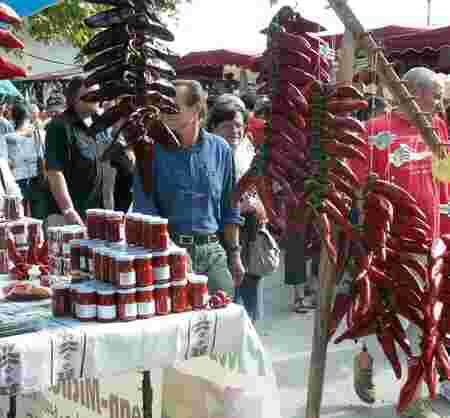
While Arzak and Adria are all good, I'm really interested in the foods of the Basque region, the stretch of land that blends all things French with all things Spanish. It's a happy marriage, at least as far as the food is concerned, with the cheeses (look for Bleu des Basques and other sheep's milk cheeses, among them Erhaki, Ossau-Iraty and Petit Basque) of particular note. But perhaps the best thing to come out of Basque country is Piment D'Espelette. This dried, powdered red pepper resembles true Spanish paprika, and shares with paprika a warm, smoky, rich flavor. Underlying the mild heat is sweetness that reminds you that the peppers used in Piment D'Espelette are picked when dead-ripe, then sun-dried for two to three months to concentrate their flavo, after which they are quickly broiled and ground to a powder. Like a lot of great European foodstuffs, true Piment D'Espelette has been awarded with D.O.C status (Denominacion d'Origine Controle). D.O.C status means that Piment D'Espelette can only be produced in certain areas, during certain times of the year, and that production must adhere to standards that dictate everything from how ripe the peppers can be before harvest to how they must be dried and powdered. Giving a product D.O.C status protects its integrity and tradition, but it also keeps a lot of cheap imitators from producing inferior product and claiming it's the real thing. Currently, only 10 Basque villages are allowed to produce piment.
Espelette Pepper, also known in the Basque dialect as Ezpeletako BiPerra, is the ideal spice for fish and potatoes, for scrambled eggs, for little garlic crostini with white bean spread, for roast lamb...basically, it's the ideal spice. Best of all, unlike loads of kitchen tools, ingredients, and gadgets, a bottle of Piment is relatively inexpensive and will last for a long time in your kitchen, enlivening lots of formerly drab meals. At the end of October each year, a Piment D'Espelette festival is held in the Basque region. Having never seen it myself, I can only imagine that it's an unparalleled culinary event.
San Francisco chef Gerald Hirigoyen has a Basque restaurant here in the city, aptly named Piperade. Below, his recipe for--what else? Piperade! Piperade could be considered the building block of all Basque dishes, and it highlights the regional foods of Basque country--tomatoes, garlic, and piment.
Gerald Hirigoyen's Piperade
1/2 cup olive oil
1 small onion, finely sliced
6 anaheim chiles, seeded and finely sliced
6 garlic cloves, sliced
6 ripe tomatoes, peeled, seeded and chopped
1 tsp. sugar
1/8 teaspoon Piment D'Espelette
1 bay leaf
salt and pepper
Heat the olive oil in a saute pan over medium heat. Add the onions, chiles and garlic and cook for 5 minutes. Add the tomatoes, sugar, piment d'espelette and bay leaf, and season to taste with salt and pepper. Bring to a boil, stirring occasionally, then reduce the heat and simmer 25-30 minutes, stirring occasionally. Discard the bay leaf and serve warm, alongside eggs for an elegant brunch, or with fish, lamb, or chicken.
Tuesday, October 04, 2005
Mr. Bond's Culinary Capers
I've been thinking a lot about my friend Jason lately, a very talented chef who has taken his talent of the wilds of New Hampshire, to L.A. Burdick's restaurant in Walpole. Burdick's is best known for their handmade chocolates, particularly their tiny chocolate mice with almond ears, but soon enough, I'm sure, their restaurant will begin diverting attention away from those mice.
www.burdickchocolate.com
Jason has proven himself an eager and willing dining and cooking companion, and I can't help but get nostalgic thinking about all of our culinary triumphs and experiments. There were roasted pumpkin seeds at Halloween, fruitcakes at Christmas (we had a blind fruitcake taste test one year, his mom's vs. my mother-in-laws), and a particularly trying gastronomic vacation to Alsace where, as guests of the board of tourism, we ate cabbage and pork knuckles for a week, washed down with local beer. We even had beer soup.
Jason singlehandedly cooked the meal for my wedding, a feast of modest proportions that consisted of boudin blank, flank steak and pork loin (heretofore referred to as "mixed grill"), bowls of sliced summer tomatoes with sea salt, corn salad with feta and herbs and a spicy peach chutney. He also cooked a meal for my very-important guest, the cookbook author Anne Willan, back when he was chef at a restaurant in Boston. Anne is a woman who takes her dining very seriously, particularly French food. So when Jason turned out pate a choux with black truffles and a rabbit dish with a sauce made from the bunny's own blood....well, let's just say it was a job well done. Of course, who can forget the time he pulled into the driveway with a whole baby lamb wrapped in plastic sheeting in the trunk of his car, then proceeded to make an Easter dinner that would make any Greek proud, replete with lamb two ways, braised and roasted.
Along the way, of course, were failures. What friendship is without them? There was the New Year's Day morning when Jason waved a tin of kippers under my nose, sending my champagne-weary stomach into knots. There was the red velvet cake I made for his birthday, a monstrosity so sweet that eating it was an act of deep friendship. There was the cake he made for our friend Sarah, scorched beyond recognition, but baked in a heart-shaped pan.
If a friendship can be charted by gastronomic highs and lows, ours is complete. I raise my glass to you, Mr. Bond, and the empanadas, galettes, sausages and cocktails still to come.
www.burdickchocolate.com
Jason has proven himself an eager and willing dining and cooking companion, and I can't help but get nostalgic thinking about all of our culinary triumphs and experiments. There were roasted pumpkin seeds at Halloween, fruitcakes at Christmas (we had a blind fruitcake taste test one year, his mom's vs. my mother-in-laws), and a particularly trying gastronomic vacation to Alsace where, as guests of the board of tourism, we ate cabbage and pork knuckles for a week, washed down with local beer. We even had beer soup.
Jason singlehandedly cooked the meal for my wedding, a feast of modest proportions that consisted of boudin blank, flank steak and pork loin (heretofore referred to as "mixed grill"), bowls of sliced summer tomatoes with sea salt, corn salad with feta and herbs and a spicy peach chutney. He also cooked a meal for my very-important guest, the cookbook author Anne Willan, back when he was chef at a restaurant in Boston. Anne is a woman who takes her dining very seriously, particularly French food. So when Jason turned out pate a choux with black truffles and a rabbit dish with a sauce made from the bunny's own blood....well, let's just say it was a job well done. Of course, who can forget the time he pulled into the driveway with a whole baby lamb wrapped in plastic sheeting in the trunk of his car, then proceeded to make an Easter dinner that would make any Greek proud, replete with lamb two ways, braised and roasted.
Along the way, of course, were failures. What friendship is without them? There was the New Year's Day morning when Jason waved a tin of kippers under my nose, sending my champagne-weary stomach into knots. There was the red velvet cake I made for his birthday, a monstrosity so sweet that eating it was an act of deep friendship. There was the cake he made for our friend Sarah, scorched beyond recognition, but baked in a heart-shaped pan.
If a friendship can be charted by gastronomic highs and lows, ours is complete. I raise my glass to you, Mr. Bond, and the empanadas, galettes, sausages and cocktails still to come.
Sunday, September 25, 2005
Surprise! French Fries are bad for you
The New York Times reported some hard-hitting news last Wednesday. French Fries are bad for you, and the State of California thinks you should know. Turns out fried potatoes have high levels of acrylamide, which has been shown to cause cancer in lab rats and mice. The attorney general of California is now recommending that french fries and potato chips carry warning labels, like those found on cigarette packages and solvents.
But prune juice also has high levels of acrylamide, and black olives and wheat bread. Fortunately, black olives, prunes and wheat toast haven't quite caught on in the same way that fries and chips have. But what ever happened to personal responsibility? Do we really need warnings to remind us not to gorge ourselves at McDonald's?
But prune juice also has high levels of acrylamide, and black olives and wheat bread. Fortunately, black olives, prunes and wheat toast haven't quite caught on in the same way that fries and chips have. But what ever happened to personal responsibility? Do we really need warnings to remind us not to gorge ourselves at McDonald's?
Sunday, September 18, 2005
Mom's House II
I'm one of those lucky people who has a mom that is a great cook. We grew up eating what we kids considered exotica--baked ziti and lamb curry. Over the years my mother's enthusiasm and skill has grown exponentially, and in recent years she's worked in a professional kitchen in Vermont.
It might dismay her, then, to know that while I have good memories of many of the meals that we have eaten together, the recipes I'm looking for are for all for the things she hasn't made in years, maybe decades. I talked to my brother about this. He, too, remembers the cocktail meatballs, in the their curious sauce of brown sugar, ketchup and cranberry sauce (jellied, from a can) that my mother served over white rice, though he doesn't remember the apple cake, a moist spiced cake studded with chunks of local apples, which mom would make after we went apple picking each fall.
I imagine making the popcorn balls that mom used to make at Halloween for our trick-or-treaters this year, but urban suspicions prefer individually packaged mars bars to hand-wrapped homemade caramel corn.
And then there were the haystacks. These weren't really something mom cooked, just assembled. The recipe was off the box of Total cereal, and involved coconut, peanut butter and a "no-bake" approach to cooking. A few years ago I tried to get the recipe from the good people at Total. When they finally sent the recipe, or what they thought was the recipe, I filed it away without trying to make them. I was afraid that my memory of those haystacks was probably better than they ever were.
But now, the apple cake? I think that would hold up to close scrutiny.
It might dismay her, then, to know that while I have good memories of many of the meals that we have eaten together, the recipes I'm looking for are for all for the things she hasn't made in years, maybe decades. I talked to my brother about this. He, too, remembers the cocktail meatballs, in the their curious sauce of brown sugar, ketchup and cranberry sauce (jellied, from a can) that my mother served over white rice, though he doesn't remember the apple cake, a moist spiced cake studded with chunks of local apples, which mom would make after we went apple picking each fall.
I imagine making the popcorn balls that mom used to make at Halloween for our trick-or-treaters this year, but urban suspicions prefer individually packaged mars bars to hand-wrapped homemade caramel corn.
And then there were the haystacks. These weren't really something mom cooked, just assembled. The recipe was off the box of Total cereal, and involved coconut, peanut butter and a "no-bake" approach to cooking. A few years ago I tried to get the recipe from the good people at Total. When they finally sent the recipe, or what they thought was the recipe, I filed it away without trying to make them. I was afraid that my memory of those haystacks was probably better than they ever were.
But now, the apple cake? I think that would hold up to close scrutiny.
Tuesday, September 13, 2005
Mom's House
It's started to get a little chilly here in San Francisco. Since I have no idea what the weather patterns are supposed to be this time of year, it feels perfectly OK, kind of like early fall days in New England. It seems only natural to take eating cues from climactic change, and this week my thoughts are on French onion soup, lentils with sausage, braised things and sauteed greens.
Last night we went to Chez Maman, a sweet, tiny restaurant on 18th Street in Potrero Hill. It's not a sleeper or a well-kept secret, so I'm sure I'm not telling many people something that they don't already know. Run by the same folks behind Chez Papa, the larger, fancier restaurant two doors down, Chez Maman serves a small menu of French bistro-y items, from croque monsieurs (or madame's) on sweet bread that reminds me of Cuban sandwiches, to a merguez sausage panini, to great salads--particularly the endive salad, which combines chopped endive with cubed pears, candied walnuts and roquefort and the frisee salad, that Parisian classic of frisee topped with bacon and a poached egg.
The restaurant has two tiny tables in the window and a long bar that faces the open kitchen. Small wine and dessert lists round out the dinner offerings, which also include, oddly, quesadillas, and crepes. I must also mention their superior shoestring fries, served with a bright and garlicky aioli. These little potato toothpicks rival the fries at Universal Cafe (Universal mayb have a slight lead) and are quite addictive.
Last night we went to Chez Maman, a sweet, tiny restaurant on 18th Street in Potrero Hill. It's not a sleeper or a well-kept secret, so I'm sure I'm not telling many people something that they don't already know. Run by the same folks behind Chez Papa, the larger, fancier restaurant two doors down, Chez Maman serves a small menu of French bistro-y items, from croque monsieurs (or madame's) on sweet bread that reminds me of Cuban sandwiches, to a merguez sausage panini, to great salads--particularly the endive salad, which combines chopped endive with cubed pears, candied walnuts and roquefort and the frisee salad, that Parisian classic of frisee topped with bacon and a poached egg.
The restaurant has two tiny tables in the window and a long bar that faces the open kitchen. Small wine and dessert lists round out the dinner offerings, which also include, oddly, quesadillas, and crepes. I must also mention their superior shoestring fries, served with a bright and garlicky aioli. These little potato toothpicks rival the fries at Universal Cafe (Universal mayb have a slight lead) and are quite addictive.
Subscribe to:
Posts (Atom)
